These are some interesting sights on The Silk Route of North-western China.
 Yours Sincerely ( Y S ) is posing in front of a unique mosque in Turpan. No Arabic resemblances but a mixture of Mongol and Ming architecture. Who says that a mosque must look Arabic ?
 This is the Er Dao Qiao or the Grand Bazaar of Urumuqi. Better organised than the Grand Bazaar of Istanbul, Turkey. Here, you can buy anything under the sun. Ar but then, you might die haggling before you expire.
 This is the skyline of Urumugi, the capital of Xinjiang, from Hong Shan (Red Sun) Park.
 Picturesque and placid " Heavenly Lake" , a glacier lake, atop Tianshan Mountains. 1980 meters above sea level.
 The alpine view from the "Heavenly lake."
 This is another unique mosque, the Emin Minaret in Turpan.
 This is a stream which flows from a Karez, underground stream that conveys water from the aquifers in the snow capped mountains.
 The Magoa Caves or ' Caves of A Thousand Buddhas' of Dunhuang . Its numerous grottos are full of ancient Buddhist statutes and relics.
 This is the Flaming Mountain, the hottest part of China - barren, eroded, sandstone hills in the Tian Shan Mountain range in Xinjiang Province.
 This is the ruins of Gaochang ancient city of Turpan in the Gobi Desert.
 The southern Balikhun pasture of Nan Shan in the Kelawucheng Mountain range. The Kazaks still live in such abodes and herd sheep, cattle and horses.
 A common sight in rural China - Public transport.
 This is the scenic Crescent Lake oasis. It springs up right in the middle of the desert.
 The is the Grand Gate of the western portion of The Great wall of China at Jiayuguan Pass i n Gangsu. This portion marks the end of the Great Wall. In front is miles and miles of desolate Gobi Desert.
 Y S has a better understanding of an oasis.
 The oldest and original western portion of The Great Wall at Jiayuguan, Gangsu. It is awesome and totally constructed of earth !
 Y S studied about the Yellow River of China in Form Two. Y S was thrilled to see it and touch its water. The Zhongshan Bridge is the first bridge built across the Yellow River in 1907.
 This is the Yellow River Mother Statue - photography spot.
A 600-year-old water mill is still in operation, grinding corn for as long as the river flows.
 The South Gate of Xi An City Wall - massive and strong.
 The big Wild Goose Pagoda.
This is the "Tut Tut" of Xi-An.
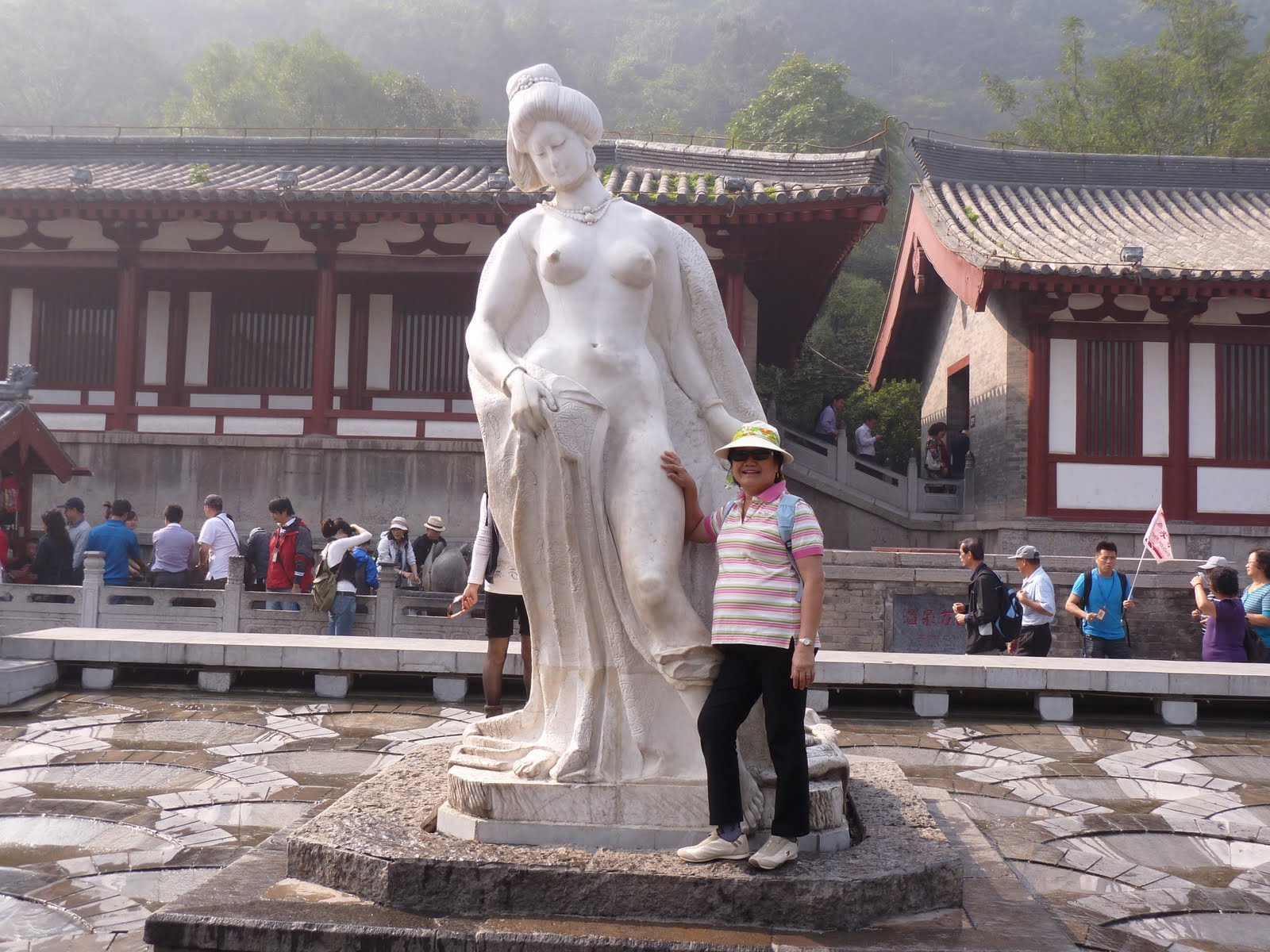 Claimed to be the statue of the renowed Yang Guifei ( 719 - 756 AD) , the prettiest woman of ancient China " who would shame any flower on earth" at Huan Garden of Huaqing Palace. ( Y S wonders whether ancient Chinese women were that proportionately endowed ?)
  These are the famous Terra Cotta warriors' massive excavation sites.
 This is claimed to be the emperor's bathing tub.
 The Hua Qing hot spring - picturesque and serene.
"Happiness is to see the world. "